

Researchers from RMIT University have helped develop a chip designed to give cameras and sensing systems access to spectral information that standard colour imaging cannot capture, potentially improving how machines distinguish between materials and environmental conditions.
The work, published in Nature Electronics, describes a method for building light-analysis capability directly into imaging hardware, aiming to reduce reliance on separate instruments typically used to measure colour and wavelength information.
The research was led by Zhejiang University in collaboration with RMIT. The team demonstrated microscopic spiral structures embedded in transparent materials that can separate light at the point of capture. The approach is intended to enable compact devices to analyse spectral data “on the spot”, with suggested applications including machine vision, automated inspection and environmental monitoring.
RMIT Distinguished Professor Baohua Jia said the approach changes where light separation occurs in an imaging system.
“This is not about adding more image processing after the fact. It introduces a new physical component that separates light at a very small scale, close to the sensor itself,” Jia said.
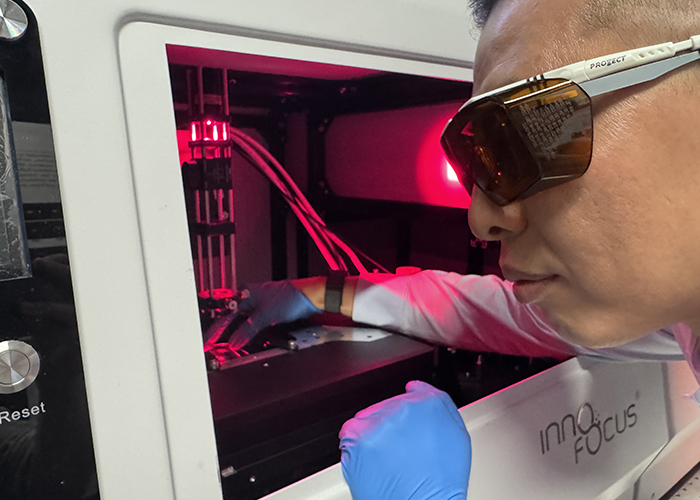
According to the researchers, the spirals were created using ultrafast laser pulses inside transparent materials and then read using a specialised optical system. The structures act as light sorters that break incoming light into distinct patterns a sensor can interpret.
The team said the technique operates across visible and near-infrared wavelengths and is less affected by viewing angle than some existing microscale approaches.
To show feasibility, the researchers integrated the structures with a commercial image sensor to demonstrate microscopic spectral imaging.
“Demonstrating that a concept works at the chip level is a critical step,” Lin said.
“It helps move the discussion from what is theoretically possible to what kinds of sensing systems could realistically be built in the future,” Qiu said.
The researchers described the work as early-stage rather than a finished product, and said next steps include scaling up fabrication, testing other materials and refining software used to reconstruct light information.
The paper, ‘Optical dispersion using micro‑vortices in thermoplastic polymers for integrated microspectrometers’, is published in Nature Electronics (DOI: 10.1038/s41928-026-01618-z).