
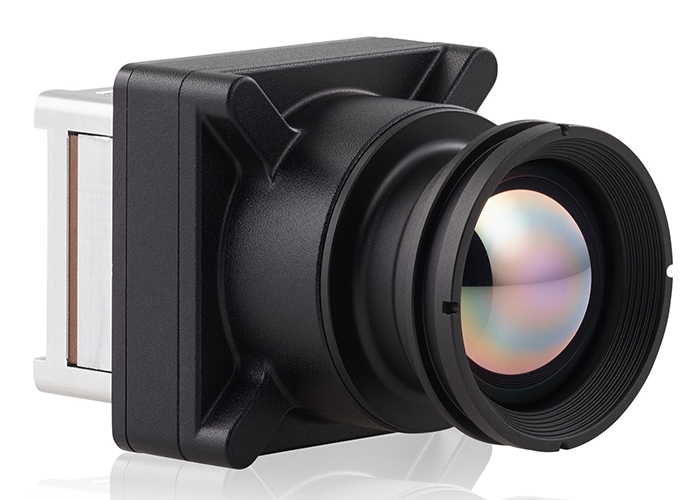
Teledyne FLIR OEM, a business unit of Teledyne Technologies Incorporated, has released the ITAR-free Boson SX8 uncooled longwave infrared (LWIR) thermal camera module, which it describes as the first NDAA-compliant product in volume production to combine an 8-micron pixel pitch with SXGA (1280 × 1024) resolution.
The company said the Boson SX8 and Boson SX8-CZ 15–75 are designed for size, weight, and power (SWaP) constrained defence and industrial applications. It positioned the modules for use cases including uncrewed aircraft systems (UAS), counter-UAS, perimeter security, handheld devices, seekers, visual augmentation, and intelligence, surveillance, and reconnaissance (ISR).
Teledyne FLIR OEM said the 8-micron pixel reduces pixel area by 55% compared to 12-micron LWIR pixel formats, and that the SXGA resolution provides four times the resolution of uncooled VGA (640 × 512) thermal camera modules, while retaining a compact form factor.
“By reducing pixel area by 55% compared to the standard 12-micron LWIR pixel format, Boson SX8 represents a transformational moment for thermal imaging,” said Paul Clayton, President, Teledyne FLIR OEM. “By pairing this advanced 8-micron pixel architecture with SXGA thermal resolution at full-rate production, we’re giving customers greater situational awareness and longer effective range without compromising SWaP or supply-chain confidence.”
The company also announced the Boson SX8-CZ 15–75, which includes a factory-integrated 5x continuous-zoom lens. Teledyne FLIR OEM said the module is paired with a 15–75 mm continuous-zoom lens and calibrated as a single system, with features including focus-through-zoom, thermal gradient compensation, and factory alignment.
The release comes as defence, border, and critical infrastructure operators continue to seek higher-resolution thermal imaging in smaller payloads, particularly for drones and mobile platforms, while also navigating procurement restrictions that prioritise supply-chain assurance through compliance requirements such as the US National Defense Authorization Act.