
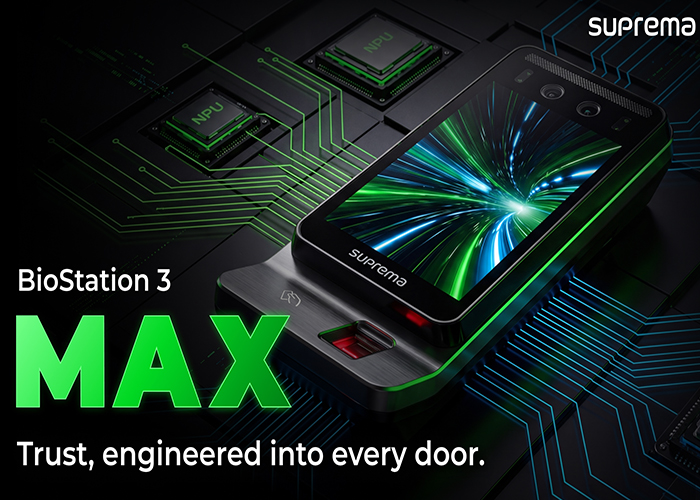
Suprema has announced the launch of BioStation 3 Max, an AI-enabled biometric terminal positioned by the company as its flagship device for access control and identity authentication.
According to Suprema, the terminal supports multiple authentication options including face and fingerprint biometrics, as well as RFID, mobile, QR and PIN credentials. The company said the device is built on a hardened Linux operating system with Secure Boot intended to ensure only signed firmware executes.
Suprema said BioStation 3 Max includes a Common Criteria EAL6+ certified secure element for storing credentials and cryptographic keys, and that biometric templates are encrypted with device communications secured using TLS. The company also stated the terminal includes an active tamper response designed to trigger alerts in the event of physical compromise.
For deployments with privacy requirements, Suprema said the terminal supports “Template-on-Mobile” and “Template-on-Card” configurations, which store biometric data on a user’s device or smart card rather than on centralised servers.
On performance claims, the company said the terminal can match faces in under 0.3 seconds using a dedicated neural processing unit, and uses dual 2MP visual and infrared cameras for liveness detection and anti-spoofing against printed photos, replayed videos and 3D masks. Suprema said the system is designed to function under conditions such as sunglasses, masks, varied angles and changing lighting, and can scale to 100,000 enrolled users.
Suprema said the device features a 7-inch IPS touchscreen providing prompts and guidance, and includes a built-in VoIP intercom with SIP integration for attended entrances. The company said BioStation 3 Max carries IP65 and IK06 ratings and supports speed-gate and wall mounting, with PoE+ available on select models.
“BioStation 3 Max defines the new standard for identity-first security,” said Hanchul Kim, CEO of Suprema Inc. “Biometric authentication, certified hardware security, and superior AI performance, brought together in one flagship terminal. Trust, engineered into every door.”
The announcement comes as access control terminals increasingly operate as network-connected endpoints, raising the stakes for device-level hardening, credential protection and update integrity in environments where physical security and cyber security risks intersect.