
Bosch has set out financial targets for 2026 and reiterated its “Strategy 2030” priorities, as it reported 2025 results that included lower operating margins and significant restructuring provisions.
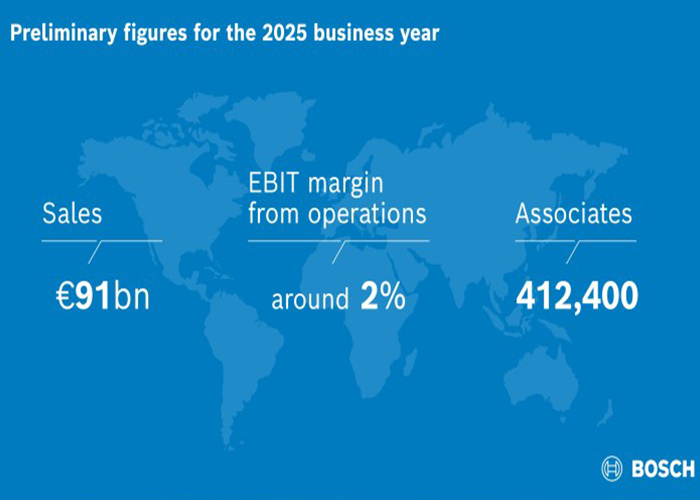
The Bosch Group said 2025 sales revenue was 91.0 billion euros, slightly up from 90.3 billion euros in 2024. After adjusting for exchange-rate effects, Bosch said sales growth was 4.1 percent. The EBIT margin from operations fell to 2.0 percent from 3.5 percent a year earlier, which the company attributed in part to structural and personnel adjustments, including provisions of 2.7 billion euros.
For 2026, Bosch is forecasting sales growth of 2–5 percent and an EBIT margin from operations of 4–6 percent, with positive free cash flow. The company said it intends to maintain high upfront investment levels in areas it considers strategically important, noting that in 2025 it spent about 12 billion euros on research and development and capital expenditure combined.
Stefan Hartung, chairman of the board of management of Robert Bosch GmbH, linked the 2026 outlook to cost reductions and product development across business areas, pointing to trends including automation, digitalisation, electrification and artificial intelligence. “Bosch can deliver the future – even under unfavorable conditions. 2026 will be a year of progress,” Hartung said.
Bosch also highlighted its patent activity, saying it registered around 6,300 patents in 2025 and remained the leading applicant in Germany.
In Southeast Asia and Oceania, Bosch reported total net sales of AUD$5.13 billion (2.93 billion euros) in 2025, including non-consolidated companies and internal deliveries to affiliated companies. Consolidated sales to third parties in the region were AUD$2.98 billion (1.7 billion euros). Bosch said performance varied by sector, with contributions from mobility and two-wheeler businesses, as well as factory automation and hydraulic technologies.
Robert Hesse, president of Bosch in Southeast Asia and Oceania, said the company’s regional priorities align with “Strategy 2030” areas including AI, software-driven mobility and HVAC solutions. He said Bosch would increase its focus on innovation through its research and development hub in Singapore, which he said is working on technologies for HVAC, robotics and AI, alongside partnerships intended to support competitiveness.
Bosch said it employed more than 14,000 associates across Southeast Asia and Oceania as at 31 December 2025, including over 12,800 in Southeast Asia and over 1,200 in Oceania.
As part of its broader competitiveness measures, Bosch said it had concluded talks with employee representatives on job cuts at affected mobility locations in Germany, describing the changes as part of efforts to respond to price pressure in the automotive sector.
Markus Forschner, member of the board of management and chief financial officer, said competitiveness underpins the company’s investment capacity. Bosch also said it plans, for the first time, to publish interim consolidated financial statements and an interim group management report for the first half of the business year, which it said would allow more flexibility in issuing financial instruments such as bonds.
In its 2025 financial summary, Bosch reported free cash flow of about 300 million euros, down from about 900 million euros in 2024. It said its R&D ratio was 8.7 percent of sales, with research and development spending of 7.9 billion euros. The equity ratio was 41.6 percent, down from 44.3 percent, while liquidity fell to 7.4 billion euros from 8.2 billion euros.
By business sector, Bosch reported that Mobility sales rose 0.1 percent to 55.8 billion euros, while the EBIT margin from operations in that segment fell to 1.8 percent from 3.8 percent. Industrial Technology sales increased 0.1 percent to 6.5 billion euros, with an EBIT margin from operations of 3.5 percent, up from 1.2 percent. Consumer Goods sales fell 1.9 percent to 19.9 billion euros, with an EBIT margin from operations of 3.0 percent, down from 3.5 percent. Energy and Building Technology sales rose 13.0 percent to 8.5 billion euros, but the EBIT margin from operations fell to 0.5 percent, which Bosch said was influenced by one-off costs from acquisitions and sales activities.
By region, Bosch said sales in Europe declined 0.6 percent to 44.2 billion euros, while sales in the Americas increased 3.8 percent to 18.5 billion euros and Asia Pacific sales rose 0.7 percent to 28.3 billion euros. Adjusted for exchange-rate effects, Bosch reported growth of 1.5 percent in Europe, 9.3 percent in the Americas and 5.0 percent in Asia Pacific.
Group headcount at the end of 2025 was 412,774 associates, down from 417,859 in 2024, a reduction of about 5,085 associates, which Bosch said was most pronounced in the Mobility business sector and in Germany.