Genetec has introduced a new high-density appliance aimed at large-scale security deployments, positioning it as a way for enterprises to expand cloud-managed physical security without abandoning existing infrastructure or committing to cloud-only storage.
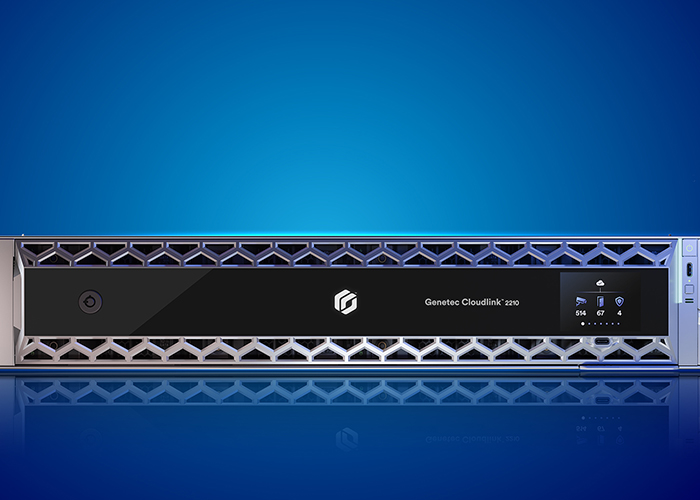
The company says the new Cloudlink 2210 is a 2U rack-mount appliance addresses practical barriers that have slowed cloud-managed adoption in enterprise environments, including rising cloud storage costs, legacy devices that lack direct-to-cloud capability, and the need to maintain local functionality during network outages.
Cloudlink 2210 supports multiple workloads — including video management, access control and intrusion detection — within a single appliance. By consolidating these functions, Genetec is targeting organisations looking to reduce system sprawl and simplify administration across large estates.
Unlike some proprietary cloud-native offerings, the appliance is built on an open architecture that supports third-party cameras, access control systems and intrusion panels. The intent, according to Genetec, is to allow organisations to modernise gradually while retaining existing hardware and avoiding full rip-and-replace upgrades.
Christian Chenard Lemire, Product Director, Unified Solutions at Genetec, said enterprises are seeking a balance between innovation and operational certainty.
“With Cloudlink 2210, we’re redefining what cloud-managed physical security looks like at scale by giving organisations the freedom to modernize on their own terms, control long-term costs, and maintain the resiliency and continuity their most critical environments demand,” he said.
From a technical standpoint, the appliance supports hundreds of connected devices per unit and offers up to 240TB of local storage. The emphasis on high-capacity local retention reflects continued enterprise concerns about bandwidth usage and ongoing cloud storage expenditure, particularly in environments with extended video retention policies.
Resiliency features include RAID-protected storage, redundant system components and dual network interfaces designed to support both redundancy and network isolation. Security workloads continue to operate locally if cloud connectivity is disrupted — a critical factor for sectors such as transport, healthcare, utilities and critical infrastructure where downtime is not acceptable.
Scalability is achieved by adding additional units as device counts and storage requirements grow, rather than rearchitecting the broader system. Centralised cloud management is maintained across deployments, enabling oversight of distributed sites within a unified management framework.